Discover Geeks Academy’s articles on: Blockchain, Coding, Cybersecurity, Cloud, Big Data, Artificial Intelligence, Gaming, Digital Innovation
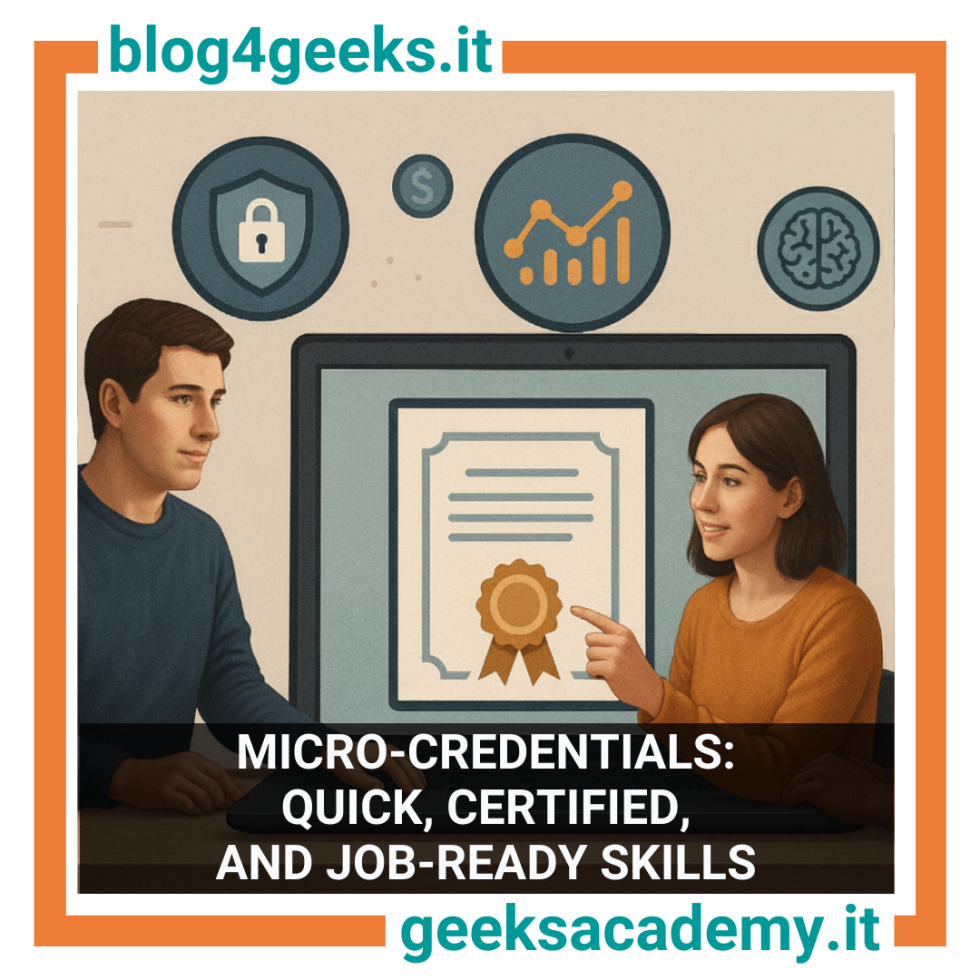
In today’s job market, where everything changes at an impressive speed, micro-credentials are gaining ground as a concrete response to the need for learning new skills quickly and effectively. No long, theoretical paths—instead, these are short, highly practical courses with a certification that is immediately marketable. Whether it is cybersecurity, data analysis, or even generative AI, these certifications are proving to be key tools for building or relaunching a career.
The European Commission has defined micro-credentials as "the record of the learning outcomes that a learner has acquired following a small volume of learning." They are a central part of the EU Skills Agenda strategy to promote lifelong learning, reskilling, and upskilling.
Micro-credentials in Simple Terms
In short: a micro-credential is an official certification that validates a targeted and measurable skill. Obtained through a short—often digital—pathway, it is designed to be immediately applicable in the workplace. These are intensive courses, typically lasting between 2 and 12 weeks, focused on delivering a specific technical competency.
Upon completion, participants receive a recognized certificate, often backed by universities, academies (such as Geeks Academy), accredited platforms, or tech giants like Google, Microsoft, or IBM. The goal is clear: learn something useful and certify it without wasting months or years.
Why They Are Becoming So Important
A 2025 survey conducted by Coursera in collaboration with the Lumina Foundation gathered insights from over 2,000 students and recruiters. The results are compelling:
- 85% of students state that a micro-credential helped them find a job.
- 90% of employers consider them relevant or very relevant in the hiring process.
- 96% of recruiters view them as a positive sign of motivation and continuous learning.
- Nearly 9 out of 10 have hired at least one person with this type of certification.
For junior profiles, the impact is even more significant. Those who completed a micro-credential saw a salary increase in over 28% of cases and a promotion in 21% of cases. Furthermore, over 70% reported feeling more productive, and 83% felt better prepared to take on new roles or career changes.
The Economic Impact
Completing a micro-credential course can lead to an average salary increase of up to 15%. Simultaneously, many companies report a 10% to 30% reduction in training costs. This is because employees entering a company with certified skills require fewer hours of onboarding or internal training.
Who Are They Really For?
Recent Graduates: To add something practical and concrete to their CV.
Evolving Professionals: Who need to stay updated with industry trends.
Career Changers: Those looking for a new direction or re-entering the workforce.
University Students: Who want to complement theoretical knowledge with operational skills.
Where Can You Find Them?
Today, micro-credentials are offered by numerous platforms:
- LinkedIn Learning: Featuring verifiable badges visible on your profile.
- Geeks Academy: Through its "SPRINT" courses.
- Coursera: Partnering with Google, Meta, IBM, and Intuit.
- edX: Offering MicroMasters and Professional Certificates.
- Udacity: Known for its famous "Nanodegrees."
- Others: FutureLearn, Skillshare, and various Italian universities and local professional bodies.
Current Trends and Open Challenges
95% of employers recognize micro-credentials as a sign of proactivity. However, nearly half (46%) still express concerns regarding quality or the lack of clear standards. This is driving many institutions to work toward more uniform frameworks. Interestingly, according to AACSB (the international body accrediting top business schools), 51% of universities already recognize credits for these courses, and 82% plan to do so within the next five years.
Despite the growth, some hurdles remain:
Lack of a shared international standard.
Skepticism from some universities that view them as "minor" or unstructured paths.
Variable quality across platforms, requiring careful selection by the user.
Conclusion
Today more than ever, staying updated is essential. Doing so in a way that is fast, certified, and targeted provides a distinct competitive advantage. Micro-credentials offer exactly that: a short, concrete, and recognizable path. They deliver visible results not only in terms of skills but also economically and professionally. Whether you are at the start of your journey, in a transition phase, or simply looking to improve, a micro-credential can truly make the difference.