Over the past few years, we've witnessed the democratization of artificial intelligence. Powerful AI tools have become accessible to virtually everyone. But businesses are now taking the next step. They don't simply want to use AI anymore, they want to own it, control it, and adapt it to their data.
A new professional role is emerging almost quietly, yet at remarkable speed: the AI Solutions Specialist.
This isn't just another technology job. It's where strategy, technology, and business converge. And all signs suggest it will become one of the most in-demand professions of the next decade.
Meanwhile, public debate continues to swing between enthusiasm and fear. Many people believe artificial intelligence will eliminate jobs. The reality, however, is far more interesting: work isn't disappearing—it's evolving. And someone will need to lead that transformation.
From AI as a Tool to AI as a Strategy
Over the past few years, artificial intelligence has evolved from an experimental technology into a fundamental business infrastructure. It's no longer simply about using a tool or automating a few tasks. Organizations are now facing a much deeper challenge: rethinking entire business models.
This is where the AI Solutions Specialist comes in.
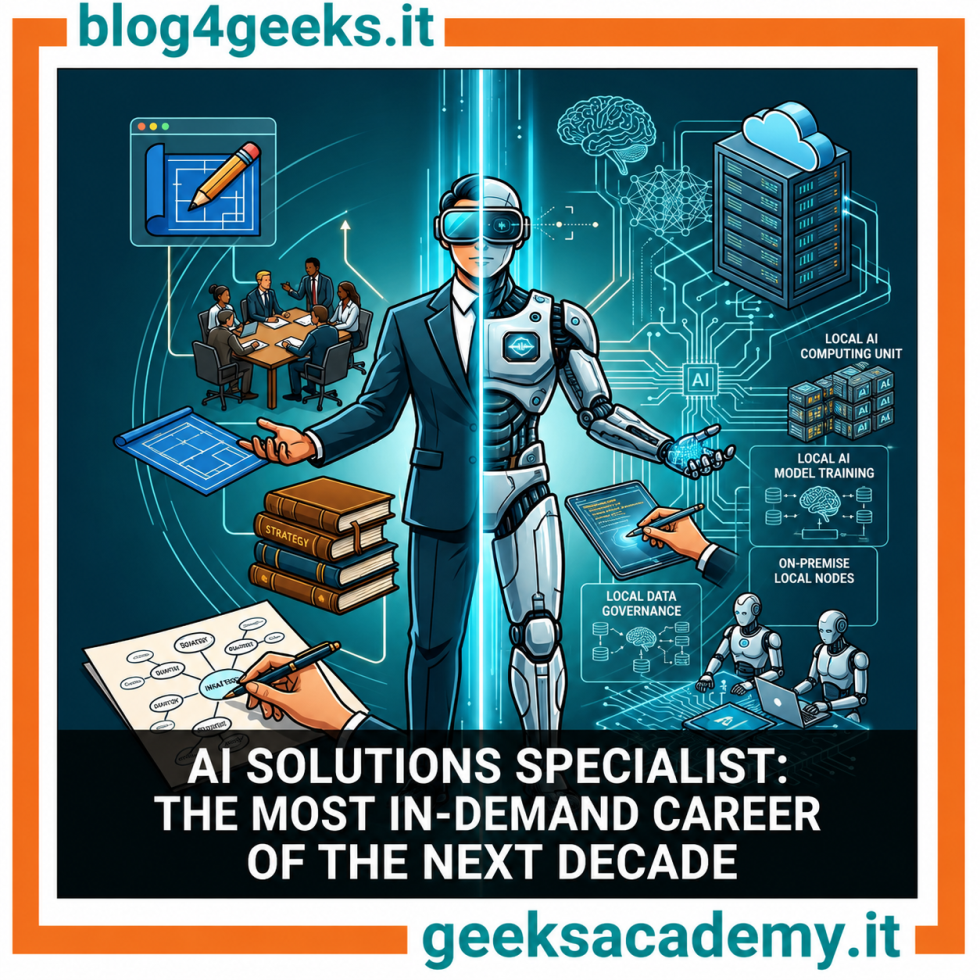
This professional is neither a traditional software developer nor a pure data scientist. Instead, it is a hybrid role that combines business understanding with technical expertise. AI Solutions Specialists translate complex business challenges into practical AI solutions, integrate technologies and processes, measure outcomes, and evaluate their overall impact.
Simply put, they serve as the bridge between technology and real business value.
And today, that bridge is still missing in many organizations.
The AI Paradox: Everyone Wants It, Few Know How to Use It Well
Globally, we're witnessing an interesting paradox: AI is everywhere, but only a small number of organizations are using it effectively—and even fewer are deploying it locally or privately.
Companies are investing in AI initiatives, experimenting with new technologies, and purchasing sophisticated tools. Yet many stop there. What's often missing is the ability to integrate AI securely and systematically into everyday business processes.
The question is no longer:
"Do we need AI?"
The real question has become:
"Who knows how to implement it successfully?"
And that is precisely why the AI Solutions Specialist is becoming increasingly important.
The Real Game Changer: On-Premise AI
The story becomes even more compelling when we consider one of today's most significant technological shifts: the transition from cloud-based AI to on-premise, privately controlled AI systems—often referred to as enterprise AI.
Over the past few years, AI has become widely accessible. Now businesses are taking things a step further.
They don't simply want to use AI.
They want to own it, control it, and tailor it to their unique business needs.
There are several compelling reasons for this shift:
-
Protecting sensitive information
-
Meeting regulatory and compliance requirements (particularly in Europe)
-
Safeguarding corporate know-how and intellectual property
-
Achieving greater customization and flexibility
On-premise AI addresses these needs by allowing organizations to deploy AI models within their own infrastructure, without relying exclusively on external services.
AI is no longer merely a productivity tool—it is becoming an internal competitive advantage.
AI as an Internal Competitive Advantage
This paradigm shift is already having a profound impact.
Leading organizations are:
-
Deploying open-source AI models locally
-
Building internal AI agents and assistants
-
Automating business processes using proprietary data
-
Reducing dependence on external platforms and services
The result?
AI is no longer simply another software application. It becomes part of an organization's nervous system.
And when that happens, competitive advantages become significantly more difficult to replicate.
A Role Becoming Increasingly Strategic
Within this new landscape, the role of the AI Solutions Specialist continues to evolve.
Knowing how to use AI tools is no longer enough.
Organizations increasingly need professionals who can:
-
Design AI architectures (cloud-based, hybrid, or on-premise)
-
Integrate AI models into existing business systems
-
Manage data security, governance, and compliance requirements
-
Transform AI initiatives into scalable infrastructures
In other words, AI Solutions Specialists are the professionals who move AI beyond experimentation and turn it into something that delivers measurable value every single day.
Cloud vs. On-Premise: The Real Answer Is "It Depends"
Cloud and on-premise solutions are often presented as competing alternatives.
In reality, the future will be increasingly hybrid.
Cloud environments offer:
-
Speed
-
Scalability
-
Rapid experimentation
On-premise solutions provide:
-
Greater control
-
Enhanced security
-
Extensive customization capabilities
The true value doesn't lie in choosing one over the other. It lies in understanding how to combine both intelligently.
And that capability is not merely technical—it's strategic.
A Rapidly Expanding Market
Demand for AI-related skills is already growing rapidly, but the nature of that demand is changing.
Organizations are no longer seeking only highly specialized technical experts. They're looking for professionals capable of bringing AI into real-world business environments—often complex, regulated, and mission-critical.
Industries such as:
-
Financial services
-
Healthcare
-
Manufacturing
-
Public administration
are accelerating their adoption of enterprise AI solutions. In many cases, on-premise AI is quickly becoming a fundamental requirement.
Translated into market terms, this means:
More responsibility. More complexity. More opportunities.
And significantly greater professional value.
The Skills That Will Make the Difference
The AI Solutions Specialist is, above all, a multidisciplinary professional.
Success in this role requires a combination of:
Technical Skills
-
AI models and architectures
-
Systems integration
-
Automation technologies
-
Cloud and on-premise infrastructures
Strategic Skills
-
Business process analysis
-
ROI evaluation
-
Architectural decision-making
-
AI adoption strategies
Soft Skills
-
Problem-solving
-
Communication
-
Systems thinking
-
Leadership and collaboration
Because AI isn't a product that can simply be installed.
It's an ecosystem that must be thoughtfully designed.
Looking Ahead
Over the next decade, we are likely to see three major trends emerge:
-
Significant growth in on-premise AI adoption, particularly across Europe.
-
Increasing demand for hybrid professionals capable of bridging AI and business strategy.
-
A transition from simply using AI tools to designing and implementing AI-powered solutions.
Ultimately, organizations won't compete based on who has access to AI.
They will compete based on who applies it more effectively than everyone else.
Conclusion: A Profession Destined to Become Essential
Every technological revolution creates new professions.
The Internet gave rise to social media managers. Mobile technologies created app developers.
Artificial intelligence is driving something even more profound: the emergence of professionals capable of reimagining entire business models.
The AI Solutions Specialist is one of them.
This isn't simply a job of the future—it's the answer to one of today's most pressing challenges.
Businesses already have access to AI technologies. What they often lack is the expertise required to implement them successfully.
Those who learn how to bridge that gap are unlikely to struggle when searching for opportunities.
If anything, their greatest challenge may simply be choosing among them.
Artificial intelligence is changing the future of work. The professionals who will shape that future won't necessarily be those who build the most advanced algorithms, but those who know how to transform technology into real-world value.